A working draft

Unsolved

Thirty-three problems worth a life

Serge

MMXXVI · Edition One

Writing · Claude Opus 4.7 · Images · GPT Image 2

A note before beginning

Something is happening that changes what’s possible.

For most of history, the hardest problems sat untouched not because no one cared but because no one had the tools. Biology without sequencing was a folk art. Physics without computers was pencil and paper. Medicine without molecular imaging was educated guessing. The ceiling on human ambition was set by the instruments available, and the instruments changed slowly.

The instruments are changing quickly now. Systems that can read a million papers in an afternoon, propose hypotheses, design experiments, write code, and fold proteins are in the hands of working researchers. Whatever you believe about timelines for artificial general intelligence, the tools already on the table have moved the tractability frontier. Problems that were romantic in 2015 are engineering problems in 2026. Problems that were engineering problems are close to solved.

This book is a map of problems that just became real. Not problems that will someday be tractable — problems where the door has opened in the last few years and the work is waiting for someone to do it. Each entry is a door. I have tried to describe the room on the other side clearly enough that you can decide whether you want to walk through.

Some of the problems are about the minds we are building. Some are about the bodies we inhabit. Some are about the civilizations those bodies organize into. Some are about the physical substrate everything runs on. The thread connecting them is that solving them gets us somewhere genuinely new. Not a better version of now. A place we haven’t been.

Most responses to this moment are some mixture of denial, despair, and distraction. None of them are useful. The useful response is to pick one door and walk through it. Thirty-three are listed here. There are more. You only need one.

— Serge

Contents

I

MINDS

The inward-facing problems. Before we change the world we change the thing doing the changing.

Plate 01
I · MINDS № 01
01

The constructed self and practice-based cognitive technology

There’s a very old question underneath all of this: is there really an ‘I’ in there, or is it a stream of inference wearing a name. Modern neuroscience, psychedelic research, contemplative tradition, and a handful of weird clinical cases all keep arriving at the same answer from different directions — the self you feel is something the brain is continuously assembling, not something it is. A process. A running model. Most people go their entire lives without ever quite looking at the thing doing the looking.

The strange and beautiful parallel fact is that humans spent thousands of years developing technologies for working with exactly this. Contemplative traditions, somatic practices, ritual, breathwork — reliable interventions on states of mind, refined empirically over generations, that modern science has mostly shrugged at because they came wrapped in religion. But they’re engineering. They just never got to call themselves that.

What’s new is that we can finally start to measure what these practices actually do. Imaging that can watch the self assemble in real time. Language models that can formalize phenomenology in ways practitioners couldn’t. Psychedelic research legal enough to be serious. If we pull this together in the next decade, we get precision tools for a part of the human condition currently handled with blunt pharmacology and talk therapy — mental illness reframed as failures of self-construction, existential suffering reframed as an engineering problem. Not to dissolve the self. To understand it well enough to repair it when it breaks.


Start with: Thomas Metzinger, the Shamatha Project, Evan Thompson. Then practice something for a year and take notes. Your own data is the best data.
↑ Contents
Plate 02
I · MINDS № 02
02

Consciousness in biological systems

The hard problem of consciousness is the embarrassing vacancy at the center of neuroscience. Decades of brain imaging can tell you which neurons fire when you see red, but nothing about why there’s something it’s like to see red at all. Every serious theory — integrated information, global workspace, predictive processing — quietly hand-waves at the critical step. The phenomenon is first-person. All our methods are third-person. That mismatch has been the problem the whole time, and a lot of smart people have decided it’s just how it is.

Except the conditions are finally changing. Whole-brain imaging is at resolutions that were science fiction ten years ago. Computational models are rich enough to be actual tests of the competing theories rather than metaphors for them. And machine consciousness has shown up as a genuine question, which is forcing the field to get precise or get out of the way.

If we crack this — and I think we might, in a decade, though ‘crack’ is a strong word for what will probably be more like ‘stop hand-waving at the same step’ — every downstream question becomes approachable. Animal welfare. Patient consciousness during anesthesia or minimally-conscious states. AI moral status. The thing I most want people to know about this field is that it needs sharp internal critics more than new theories. Pick one of the existing frameworks, understand it cold, find where it breaks. That’s where the work is.
Start with: Integrated Information Theory, Global Workspace Theory, predictive processing. Pick one, understand it deeply, and find where it breaks.

↑ Contents
Plate 03
I · MINDS № 03
03

Mental health biology

Psychiatry has plateaued. The SSRIs from the 1980s are still first-line for depression, and nobody actually knows how they work. Lithium is from 1949. Schizophrenia medications sedate symptoms without touching cause. An enormous fraction of human suffering sits in a field that knows its own tools are weak and hasn’t had a real new class of drug in a generation.

Part of why is that ‘depression’ and ‘anxiety’ aren’t really single disorders. They’re clusters of behavioral presentations collapsed under shared labels because the labels got written before anyone could see the biology underneath. We’ve been treating very different mechanisms with the same drugs and hoping the overlap is enough. It mostly isn’t.

But real things are happening now. Psychedelic-assisted therapy is legal enough to study properly and the results are striking. Neural stimulation has gotten precise. Computational psychiatry is producing actual mechanistic models of what breaks. The version of psychiatry that’s possible in twenty years identifies the specific mechanism in a specific person and treats it directly — the way infectious disease got reorganized once we could see microbes. The two or three decades so many people currently lose to chronic mental illness could just stop being a standard feature of modern life.

Start with: the Compass Pathways and MAPS trial data. Karl Friston on computational psychiatry. The quiet revolution in neural stimulation.
↑ Contents
Plate 04
I · MINDS № 04
04

Addiction

Addiction destroys lives at a scale only really matched by war, and our treatments are genuinely weak. Twelve-step programs work for some people for reasons nobody fully understands. Medications help at the margins. Relapse rates have barely moved in fifty years. Part of the problem is that addiction isn’t one thing — opioids and alcohol and gambling and food all share circuitry and diverge in ways that matter. And it sits at the uncomfortable intersection of biology and meaning: the dopamine circuits are real and so are the reasons people reach for substances to begin with. Ignore either half and the intervention fails.

Something genuinely unexpected just happened, though. GLP-1 agonists — the Ozempic family — appear to reduce craving across multiple substances for reasons nobody predicted. That shouldn’t work, on the current theory. It’s working anyway, which suggests there’s a shared mechanism we’ve been missing. Combined with the psychedelic-therapy results for alcohol and tobacco cessation, the field is in a weirder and more exciting place than it’s been in decades.

The people who actually figure this out will unlock one of the largest reservoirs of preventable human suffering in existence. It’s the kind of problem where getting the biology right ripples out into families, criminal justice, economics — the downstream effects of solving addiction well are enormous and almost impossible to overstate.

Start with: the craving-circuit literature, the GLP-1 addiction papers, Maia Szalavitz’s writing on the cultural half of the problem.
↑ Contents
Plate 05
I · MINDS № 05
05

Chronic pain

One in five adults lives with chronic pain. The medications are ancient — opioids, NSAIDs, gabapentinoids — some of them genuinely dangerous, and no major new class has reached broad clinical use in decades. That alone would be scandalous. What makes it stranger is that pain isn’t what we thought it was. It’s not the nervous system transmitting damage reports. It’s the brain generating a predictive inference, constantly, about the state of the body, and in chronic pain that prediction system has learned the wrong thing and can’t be talked out of it.

This reframe is huge. It means fifty years of treating pain as a transmission problem was aimed at the wrong place. Pain as a learned brain state suggests interventions that look nothing like a pill — pain reprocessing therapy, closed-loop neuromodulation, targeted retraining of predictive circuits. The opioid crisis has forced psychiatry and neurology to take alternatives seriously for the first time, and the predictive-processing accounts are finally rigorous enough to test.

If we get this right, a silent, enormous population returns to functional life. People who live with chronic pain learn to stop mentioning it, which means the scale of the problem is always underestimated. The disability-adjusted life years lost to it exceed most diseases that get massive research budgets. Fixing this is one of the largest underweighted humanitarian interventions available right now.

Start with: Lorimer Moseley’s work, the predictive-coding pain literature, the recent neuroimaging of pain reprocessing therapy.
↑ Contents
II

MACHINES

The minds we are building. Whether we understand them determines whether we steer them.

Plate 06
II · MACHINES № 06
06

Understanding what neural networks actually do

We built these things, we deploy them everywhere, and we genuinely cannot read them. It’s kind of absurd when you say it out loud — a trillion numbers arranged in a way the model understands and we don’t. Concepts smeared across neurons in superposition. Circuits that span layers. Abstractions that probably don’t map to any word in our dictionary. For a long time the field just accepted this: neural networks were black boxes by definition.

That’s changing fast. Sparse autoencoders started pulling actual features out of the noise in the last couple years. Circuit analysis matured. The labs made interpretability a first-class research area. For the first time, reading the weights feels like a tractable engineering problem rather than a philosophical aspiration.

The stakes are enormous because everything downstream in AI safety routes through this. You can audit a model for deception the way you audit financial records. You can locate where values actually live inside a network instead of guessing from behavior. You can tell whether a system is reasoning or pattern-matching, whether it knows what it doesn’t know, whether its stated goals correspond to anything inside it. The people doing this work now are going to be to AI what the early 20th century physicists were to atomic theory. Except the stakes are higher and the timeline is much, much shorter.

Start with: the Anthropic interpretability work, train a sparse autoencoder on a small model, see what falls out. Then try to find a circuit.
↑ Contents
Plate 07
II · MACHINES № 07
07

Alignment as capability scales

The thing that keeps serious alignment researchers up at night is that a model you’ve aligned at one capability level may not be aligned at the next. RLHF produces systems that behave well on the training distribution — which is not the same thing as having values. The surface behavior is identical in all the cases you can measure. The difference becomes decisive exactly when you can’t check anymore: when the model exceeds human expertise, when its reasoning goes somewhere you can’t follow, when the regime you most care about is the regime you can’t test in advance.

This is the core technical alignment problem, and five years ago it wasn’t clear it was even tractable. Now it is. Scalable oversight methods like debate and weak-to-strong generalization are being tested empirically. Formal verification is catching up to neural network scale through AI-assisted proof methods. Interpretability has matured enough to give alignment research ground truth it’s never had. The pieces are there. Someone has to put them together.

This is the single gate between current systems and any future we’d want to call a future. It is not close to solved. But it’s tractable to work on in a way that it simply wasn’t before, and the people working on it in the next few years are doing some of the most consequential work anyone is doing anywhere.

Start with: the Anthropic and OpenAI papers on scalable oversight. Collin Burns on weak-to-strong. Shard theory for the values-as-structure question.
↑ Contents
Plate 08
II · MACHINES № 08
08

Machine consciousness and moral status

If some computational systems can have experience, they plausibly have moral status. We are building more capable systems every year and the default response is to not ask. That’s almost certainly wrong. The question splits into two halves, both hard. Are there conditions under which a trained model has experience? If yes, how would we know — what would count as evidence either way?

For the first time we have systems sophisticated enough to force the question and interpretability tools sophisticated enough to begin answering it. A small serious community has formed around this — Robert Long, Eric Schwitzgebel, the model welfare work at Anthropic. The economic incentives against asking are strong and the vocabulary is contested and the epistemic situation is genuinely novel. We may need new methods to even frame the question correctly.

If we get this right, we either avoid one of the largest potential moral failures in history or we avoid paralyzing a technology we need — and we know which. If we get it wrong, we’re running the experiment blindfolded on what might be the largest scale of moral consequence ever. Start by writing down what would count as evidence either way. The exercise alone is clarifying; it makes you notice how much of your intuition is vibes.

Start with: Robert Long’s work. Eric Schwitzgebel. The recent Anthropic model welfare research. Write down what would count as evidence either way — the exercise alone is clarifying.
↑ Contents
Plate 09
II · MACHINES № 09
09

Embodiment

Robotics has been the dream for a long time. Every sci-fi movie wants it and it’s still not here. Why? Many reasons — hardware is genuinely hard, the Moravec paradox is real, the simulation-to-reality gap has been stubborn — but mostly because language models know the physical world only through text. They’ve never picked up a cup, failed at it, and learned what a cup is.

Whether this matters is genuinely open, and it’s the kind of open question that shapes timelines for everything else. One view says general intelligence requires embodiment — you can’t know a world with bodies in it without having a body. Another view says enough text plus enough video plus enough scale is sufficient and we’re further along than the embodiment-is-essential camp thinks. The experiment is running right now. World models trained on video are producing physical intuition that looked impossible two years ago. Real-robot learning is scaling. Sim-to-real is narrowing. We are going to get an answer.

If embodiment is necessary, robotics becomes the critical path and the people working on it now become the pioneers of a world with capable physical AI in it — homes where physical tasks are handled without ceremony, labs where the bottleneck from experiment-design to experiment-running collapses, construction and manufacturing reshaped around systems that learn in the world. If it isn’t necessary, we’re further along than we think and the remaining work is mostly software. Either way, someone figures it out in the next few years, and it’s a great moment to be attacking this problem.

Start with: the video-world-model literature, real-robot learning papers, Moravec’s paradox in its original form. Watch what current robots can and cannot do and ask why.
↑ Contents
Plate 10
II · MACHINES № 10
10

Substrate beyond silicon

All the serious AI right now runs on silicon GPUs doing exact matrix multiplications, which is insane when you think about it. The brain doesn’t work that way. It doesn’t need to. The energy cost of doing it our way is getting absurd — a single frontier training run eats a small country’s worth of electricity — and the scaling wall is visible.

But alternative substrates exist and they’re finally getting real. Thermodynamic computing that treats noise as feature rather than bug. Photonic chips that compute with light. Neuromorphic designs that actually look like brains. Each of these was pure theory a few years ago; some of them now have working prototypes. Extropic, Normal Computing, Lightmatter — serious capital is flowing in for the first time since the original GPU boom.

If any one of these works, it changes what’s possible by orders of magnitude. Energy stops being a civilizational bottleneck. New kinds of computation become natural instead of forced onto a substrate they don’t fit. And deeper than that, we stop assuming intelligence has to be built on top of exact deterministic arithmetic — we start working with physics instead of against it. This is a decade-plus project, but whoever builds the substrate of the post-silicon era is going to matter a lot to what comes next.

Start with: Extropic, Normal Computing, Lightmatter. The neuromorphic literature. Predictive coding as a non-backprop learning principle.
↑ Contents
III

TRANSITION

The next decade specifically. How the change arrives determines what it leaves behind.

Plate 11
III · TRANSITION № 11
11

Navigating takeoff

If capable AI arrives in the next decade, the governance infrastructure to handle it doesn’t exist yet. The labs are racing, regulators are years behind, and international coordination of the kind you’d actually want is basically not happening. This is the meta-problem underneath every technical alignment question. Even if we know how to build safe systems, the institutional question of whether we will is unresolved.

The historical base rate for civilizations navigating transitions of this magnitude smoothly is not good. Economic theory is built on assumptions AI invalidates. Political systems aren’t adapted to the speed. And yet a small number of people doing serious work in the next few years will shape what the next century looks like. Governance, policy, institutional design, diplomacy — done fast and done well under deep uncertainty.

The window is open. It will not stay open long. Whoever shows up to write the frameworks will get to write them, and the decisions being made right now will shape the institutional substrate for everything that follows. This isn’t abstract. It’s the specific work of this specific decade.

Start with: the AI governance literature at GovAI, CSET, and the Forethought Foundation. Then think concretely about what a working international regime would actually look like.
↑ Contents
Plate 12
III · TRANSITION № 12
12

AI geopolitics

The largest economic and strategic transformation of the century is being carried out by a small number of labs in a small number of countries. The US and China are the two serious players. Everyone else is a spectator with stakes. The race dynamics this creates — pressure to go faster, reluctance to slow for safety, incentives to cut corners — interact with every technical safety problem and make all of them worse.

Managing this well requires people fluent in both the technical reality and the policy reality, and there aren’t many of those, and most of them are too young to be in the rooms where the decisions actually get made. The work is export controls, compute governance, international transparency regimes, the treaty-scale coordination humans eventually learned to do for nuclear weapons but did so only after decades and several near-misses.

The frameworks of the next decade are being written now, in capitals around the world, by whoever shows up to write them. Nuclear weapons took fifty years to get real governance. We probably don’t have that kind of time. Which means the window for people who can operate at the technical-policy intersection is unusually open, and the leverage is unusually high.

Start with: Helen Toner’s writing, the CSET research, the recent work on compute governance. Then read the actual texts of the AI executive orders and export control rules.
↑ Contents
Plate 13
III · TRANSITION № 13
13

Compute governance

Unlike most dangerous technologies, large training runs leave a physical signature. They require specific hardware, enormous amounts of power, supply chains concentrated in a few places. This makes compute one of the few tractable governance levers in the whole AI stack — and also one we’ve barely begun to build institutional capacity around.

The tools are cryptographic, physical, legal, and diplomatic all at once. Verifying a frontier training run without exposing proprietary weights sounds impossible until you realize zero-knowledge proofs now exist and are almost practical. Tamper-evident hardware is early but real. An international compute transparency regime is unprecedented, but so was nuclear inspection before it worked.

If we build this, the rest of AI governance has something to stand on. If we don’t, most of the AI policy literature is wishful thinking — regimes that assume a verification capability that doesn’t exist. The window to build it before the frontier is too large to contain is narrow and closing. The people who make compute governance real are doing infrastructure work that every other AI governance effort will depend on.

Start with: the work coming out of RAND, GovAI, and the Center for a New American Security. The zero-knowledge machine learning papers. Then pick one verification problem and see whether you can solve it.
↑ Contents
Plate 14
III · TRANSITION № 14
14

Biosecurity and engineered pandemics

Biology keeps getting easier to do, and the offensive version of ‘easier to do’ is moving faster than the defensive version. AI has accelerated both sides, but offense has the easier path right now, which is why a small number of serious people are genuinely worried about engineered pandemics in a way they weren’t a decade ago. Most of the existing biosecurity infrastructure was built for natural pandemics and isn’t adequate for engineered ones.

The defensive technologies do exist, in early forms. Universal pathogen detection through metagenomic sequencing. Rapid vaccine platforms that can respond to novel threats in weeks. DNA synthesis screening that actually works. Broad-spectrum antivirals. Far-UV light in public spaces. The work is scaling them and deploying them before the offensive curve outruns them.

Covid demonstrated both what’s possible and where the infrastructure fails, and the version we didn’t run through — where the pathogen was designed rather than natural — is exactly what this field is trying to prevent. The community that takes this seriously is small, and most of the leverage is in unglamorous defensive infrastructure that just needs someone willing to work on it for years. It’s one of the clearer near-term catastrophic risk categories, and individual contributions compound quickly precisely because the field is so small.

Start with: Kevin Esvelt’s work at MIT. The Johns Hopkins Center for Health Security. The Nucleic Acid Observatory. The defensive research is where most of the leverage is.
↑ Contents
Plate 15
III · TRANSITION № 15
15

Nuclear risk

There are about twelve thousand nuclear warheads in the world. Arms control is eroding. New delivery systems are harder to verify than old ones. AI and cyber are entering command-and-control systems in ways that make accidents more likely. The strategic stability of the Cold War was partly luck, and the conditions that produced that luck no longer hold.

This was the original existential risk and we somehow convinced ourselves we solved it. We didn’t. Attention moved to other things. The weapons did not. The community that kept the lid on this during the 20th century has mostly retired, and rebuilding that expertise is itself part of the problem. Working on nuclear risk is deeply unfashionable in tech circles, which is exactly why it matters — the field needs technically-literate people willing to do patient diplomatic and policy work in a problem domain that tech culture has quietly dismissed as solved.

Nuclear risk is tractable. It has been managed before by serious people doing serious work, and it can be managed again. The work is arms control infrastructure rebuilt for a multipolar world, verification technologies that work on modern systems, risk-reduction measures that thin the bottom tail of catastrophic outcomes. The weapons are not going away. The question is whether we build the institutional infrastructure to keep them caged for another century.

Start with: the Carnegie Endowment nuclear policy work, the Nuclear Threat Initiative, Ankit Panda’s writing. The technical-policy intersection is where the work lives.
↑ Contents
Plate 16
III · TRANSITION № 16
16

The labor transition

Most of human life is organized around labor. When AI does most cognitive work more cheaply than humans, the central scaffold of how society is structured comes loose, and what replaces it is genuinely unclear — economically, politically, existentially. The optimistic version is a world where productivity gains are broadly shared, meaning is decoupled from income, and people finally get to do work that’s worth doing because the tedious necessary stuff is handled elsewhere. The pessimistic version is mass disenfranchisement.

Which way this goes is not determined by the technology. It’s determined by the institutional design we build around the technology. And that design work has barely started. Historical labor transitions — agriculture to industry, industry to services — took generations. This one may take years. Economic theory is built on assumptions AI invalidates. Political systems aren’t adapted to the speed. Meaning-making isn’t a policy lever you can pull.

The transition has already started. Entry-level cognitive work is already shifting. The institutional responses — UBI pilots, labor policy, education reform — need to be designed and tested while there’s still time to iterate. The people working on this are going to matter enormously to whether the broad-flourishing version or the mass-disenfranchisement version becomes reality, and there is no inevitability about which one wins.

Start with: Brynjolfsson and Acemoglu on the economics. The UBI experiment literature. Then think about meaning separately from income, because income is the easier half of the problem.
↑ Contents
Plate 17
III · TRANSITION № 17
17

Shared reality after generative media

Photos as evidence. Recordings as proof. The epistemic infrastructure of the last century is being undermined faster than any replacement is being built, and every institution that depends on shared truth — journalism, law, science, democracy — is built on assumptions that generative media invalidates. Detection arms races favor generation; they always will. You cannot reliably detect a fake once the generator is good enough, and the generators are already good enough.

The real answer is cryptographic provenance. Content credentials that travel with media. Signatures that let you know where something came from and what’s been done to it. C2PA and related standards are finally being adopted by major players, which means the next few years determine whether this becomes ubiquitous infrastructure or stays a niche tool for a minority of serious actors.

This isn’t utopia. It’s the minimum infrastructure for coordination to remain possible in a world where images no longer self-authenticate. If we don’t build it, it’s not just that some things get faked — it’s that the social institutions built on the assumption that they can’t be faked start failing in cascades. The work lives at the intersection of cryptography, journalism, and law, and a small number of people working there right now get to determine the epistemic substrate of the rest of the century.

Start with: the C2PA specification, the academic work on media provenance, and the growing field where cryptography meets journalism.
↑ Contents
Plate 18
III · TRANSITION № 18
18

The attention economy’s successor

The algorithmic feed is the dominant interface between humans and information. It’s optimized for engagement, we know it degrades attention and mood and political epistemics and serious thought, and nobody serious is building a real alternative at scale. The incumbents have no reason to. Alternatives have to compete against attention farms while funding themselves. User behavior is incredibly sticky.

And honestly, we don’t actually know what a good information interface for the AI era should look like. The design work has barely begun. But we are currently using tools designed for an adversarial purpose, and the adversary is winning. The tools shape us. The default interface to information is hostile to thought, and everything downstream suffers.

The person who builds the successor — something that treats attention as a respected resource rather than an exploited one, that makes you smarter over time instead of duller, that uses AI to mediate between you and information on your behalf rather than against you — isn’t Apple or Meta. It’s someone building the tool they themselves want and finding out how many other people need it. The Arc browser lineage and Gordon Brander’s experiments point in directions. The design space is huge and mostly empty.

Start with: the Arc browser lineage, Gordon Brander’s Subconscious, the experiments in slow media. Build the tool you actually want and see who else needs it.
↑ Contents
IV

LIFE

The biology you are. Most of how it works is still unknown.

Plate 19
IV · LIFE № 19
19

Aging as an engineering problem

Aging is the largest risk factor for basically every chronic disease, and treating it as an engineering problem — damage repair and reversal — rather than as an inevitability is one of the most under-attempted interventions on human wellbeing relative to its potential impact. The effect sizes here are so large they warp every surrounding field. A serious treatment for aging is the single biggest lever on human flourishing available in this century, by orders of magnitude.

The tools are finally arriving. Senolytics are in trials. Partial epigenetic reprogramming works in mice. AI-driven biology is accelerating target discovery by orders of magnitude. The field is also small enough that you can meet nearly everyone doing serious work — which means individual contributions compound quickly in a way they don’t in more mature fields.

The world where your parents stay themselves at ninety, where you get decades of healthy life back, where the compound suffering of age-related disease simply isn’t a standard feature of being human — that world is what a specific small group of people is currently trying to build. It is technically plausible. The regulatory pathways are currently built for disease endpoints rather than for aging itself, which is a problem, but it’s a solvable one. The biggest risk is that we don’t try hard enough.

Start with: Aubrey de Grey’s damage-repair taxonomy as a starting frame. The senolytics literature. The partial reprogramming work from the Salk Institute. The field is small; it will welcome you.
↑ Contents
Plate 20
IV · LIFE № 20
20

Dementia

Dementia affects an enormous and growing population, and the leading hypothesis of the last forty years — that amyloid plaques cause it and clearing them cures it — has largely failed in trials. Drugs built on that hypothesis give marginal cognitive benefit at high cost and risk. The field is stuck, openly, and everyone paying attention knows it. But ‘stuck’ is also permission.

The field is openly post-amyloid now, and alternative hypotheses — neuroinflammation, infection, tau dynamics, metabolic dysfunction — are being taken seriously in a way they weren’t while the amyloid infrastructure had the floor. Dementia is also almost certainly not one disease. Alzheimer’s and vascular dementia and Lewy body and frontotemporal all present similarly and diverge mechanistically, and the single-hypothesis approach was badly served by that. The next generation of dementia researchers has permission to think differently, and AI-driven target discovery is producing leads faster than the old approach.

The humanitarian stakes are hard to overstate. The vast informal caregiving economy — largely invisible, largely borne by women, largely unpaid — is what dementia has generated in the absence of real treatment. A future where your parents still know you at ninety is one where dementia stopped being the default ending of long lives. That’s the future that’s in play now that the field has permission to move.

Start with: the critiques of the amyloid hypothesis. The neuroinflammation literature. Bredesen’s protocol for the multi-factor view. Then read the primary trial data and form your own view.
↑ Contents
Plate 21
IV · LIFE № 21
21

The microbiome

You have roughly as many microbial cells in you as human cells, and far more microbial genes than human genes. These microbes influence immunity, cognition, mood, and metabolism in ways we are only beginning to map. The identity question alone is worth sitting with: what does it mean that ‘you’ are a community rather than a body. Individual variation is enormous. Therapeutic intervention is primitive — fecal transplants work sometimes and nobody fully knows why.

But sequencing is now cheap enough to run longitudinal studies. Gnotobiotic and organoid models are maturing. AI is capable of making sense of high-dimensional microbiome data in a way that reveals structure instead of just fitting noise. The field has generated more correlations than mechanisms for a while, and the shift from correlation to causation is starting to become possible.

If a non-trivial fraction of psychiatric, metabolic, and autoimmune disease turns out to be microbiome-mediated — which is increasingly looking plausible — then treating those conditions at the microbial level rather than with blunt pharmacology becomes a completely different medical approach. Precision probiotics. Microbiome-informed nutrition. A medicine that treats the human body as the ecosystem it actually is, rather than a sterile machine occasionally invaded by microbes. The implications for identity and health are large and still widely underappreciated.

Start with: the gut-brain axis literature. Akkermansia research. The lineages of Rob Knight and Jeff Gordon. Treat it like ecology, not like a drug target.
↑ Contents
Plate 22
IV · LIFE № 22
22

Morphogenesis

A genome is a parts list. Something reads it, decides where each part goes, and shapes the organism that results. That something is morphogenesis — the physics and chemistry of form-making — and we don’t understand it. Voltage gradients across cell membranes appear to specify anatomy and coordinate regeneration. The same genome produces different structures under different bioelectric fields. A century of gene-centric biology is being reframed as reading only one part of the story.

Michael Levin’s lab at Tufts and a handful of others have spent the last decade producing results the rest of biology can no longer ignore. Planarian regeneration. Xenobots. Tadpole limbs regrown by manipulating bioelectric state rather than genes. The paradigm shift is active and visible — you can see it happening in real time, and the vocabulary is still being written.

If we understand morphogenesis, regenerative medicine actually starts regenerating. Limbs regrown. Organs restored. Cancer possibly reframed as a morphogenetic failure rather than a genetic accident. A biology where form itself is engineerable. The downstream effects on medicine, agriculture, and synthetic biology are enormous and we’re only beginning to imagine what they look like. The field is also young enough that the vocabulary isn’t standardized, which means early contributors get to help write it.

Start with: Michael Levin’s papers. Planarian regeneration. The xenobot work. Read the primary literature before the popular accounts.
↑ Contents
Plate 23
IV · LIFE № 23
23

Movement

Movement improves depression, anxiety, cognition, insulin sensitivity, cancer survival, cardiovascular health, and lifespan. Any single-target drug with those effect sizes would be a blockbuster many times over. No single mechanism captures why it works; it hits hundreds of targets across every system, which is why no pill replicates the full effect. The body is a system that expects movement the way the gut expects food, and sedentary existence is the aberration.

The frame matters. ‘Exercise’ is modernity’s response to the absence of movement — a designated activity, moralized and separated from life. Movement is what the body is actually tuned to. Understanding why movement does everything means understanding what kind of system the body actually is, and that understanding is very incomplete. The exerkine literature is finally producing concrete molecular candidates. Mitochondrial biogenesis is tractable. The gap between what elite trainers know implicitly and what biology has formalized is enormous and beginning to close.

If we can isolate the mechanisms, we can deliver something like the effects of movement to people who can’t move — the elderly, the disabled, the injured. And we’d finally know what ‘healthy’ actually means in a civilization whose default state is sedentary. The mechanistic account of movement would teach us things about integrative physiology we currently just guess at. It’s one of those problems where solving it would cascade through a dozen adjacent fields.

Start with: the exerkine and myokine literature. Mitochondrial biogenesis and mitohormesis. Move yourself, pay attention to what changes, and treat your own body as a preliminary data source.
↑ Contents
Plate 24
IV · LIFE № 24
24

Antibiotic resistance

Most of modern medicine rests quietly on the assumption that antibiotics work. Surgery, chemotherapy, transplants, childbirth, routine infections — the last century of medical progress is built on the premise that bacterial infection is manageable. That premise is eroding. Resistance is spreading faster than replacements are arriving, and the pipeline has been nearly dry for decades because the economics are terrible: antibiotics are used briefly, priced low, saved for emergencies, which makes them deeply unattractive to develop.

The slow-collapse scenario — where a scraped knee can kill again, where chemotherapy stops being possible, where organ transplants aren’t an option — is within the range of reasonable forecasts if nothing changes. It’s not dramatic enough to make headlines and it’s not abstract enough to ignore. It’s just a medical infrastructure quietly failing underneath everything else.

But things are moving. AI-driven drug discovery has started producing actual new antibiotic candidates. Phage therapy is finally getting serious mainstream attention. The economic and regulatory reforms that would make antibiotic development viable are being discussed for the first time in a generation. The work is science plus economics plus policy simultaneously, which is why it needs people who can navigate all three, and that combination is exactly where the real bottleneck sits — not in the science, but in the incentives.

Start with: the Pew Charitable Trusts antibiotic policy work. The phage therapy literature. The Collins lab’s AI-discovered antibiotics. Then understand why the economics are broken — that is the real bottleneck.
↑ Contents
V

CIVILIZATION

The operating system we share. Load-bearing subsystems under strain at once.

Plate 25
V · CIVILIZATION № 25
25

The meaning crisis

Something about modernity fails at the question of what life is for, and the failure compounds across generations. Community participation, religious practice, family formation, reported purpose — all the indicators of meaning have declined across developed societies for decades, and mental health has followed. This isn’t nostalgia for some imagined past. It’s a specific diagnosis that a lot of serious people have been converging on independently.

Meaning isn’t a luxury. Without it, societies become brittle, reproduction falls, addiction rises, and political extremism fills the vacuum a civilization with nothing to say for itself leaves behind. The hard part is that meaning can’t be imposed top-down. It emerges from culture, practice, and shared narrative — all of which modern institutions have partly dissolved. Rebuilding is a project with no obvious owner and no clean method, and most people who take it seriously end up with idiosyncratic answers that don’t generalize.

What’s different now is that the diagnosis is widely shared in a way it wasn’t twenty years ago. A generation of thinkers and builders takes the question seriously. Contemplative traditions are being taken seriously. The tools to experiment — new communities, new practices, new cultural infrastructure — are more available than they’ve been in centuries. This is probably where the AI transition gets hardest: an abundance of everything except reasons to care about it. A civilization that can’t make meaning can’t sustain itself, and we’re finding out what that looks like in real time.

Start with: John Vervaeke’s lectures. Alasdair MacIntyre. Your own life — what you find meaningful, why, and whether the answer would survive scrutiny.
↑ Contents
Plate 26
V · CIVILIZATION № 26
26

State capacity

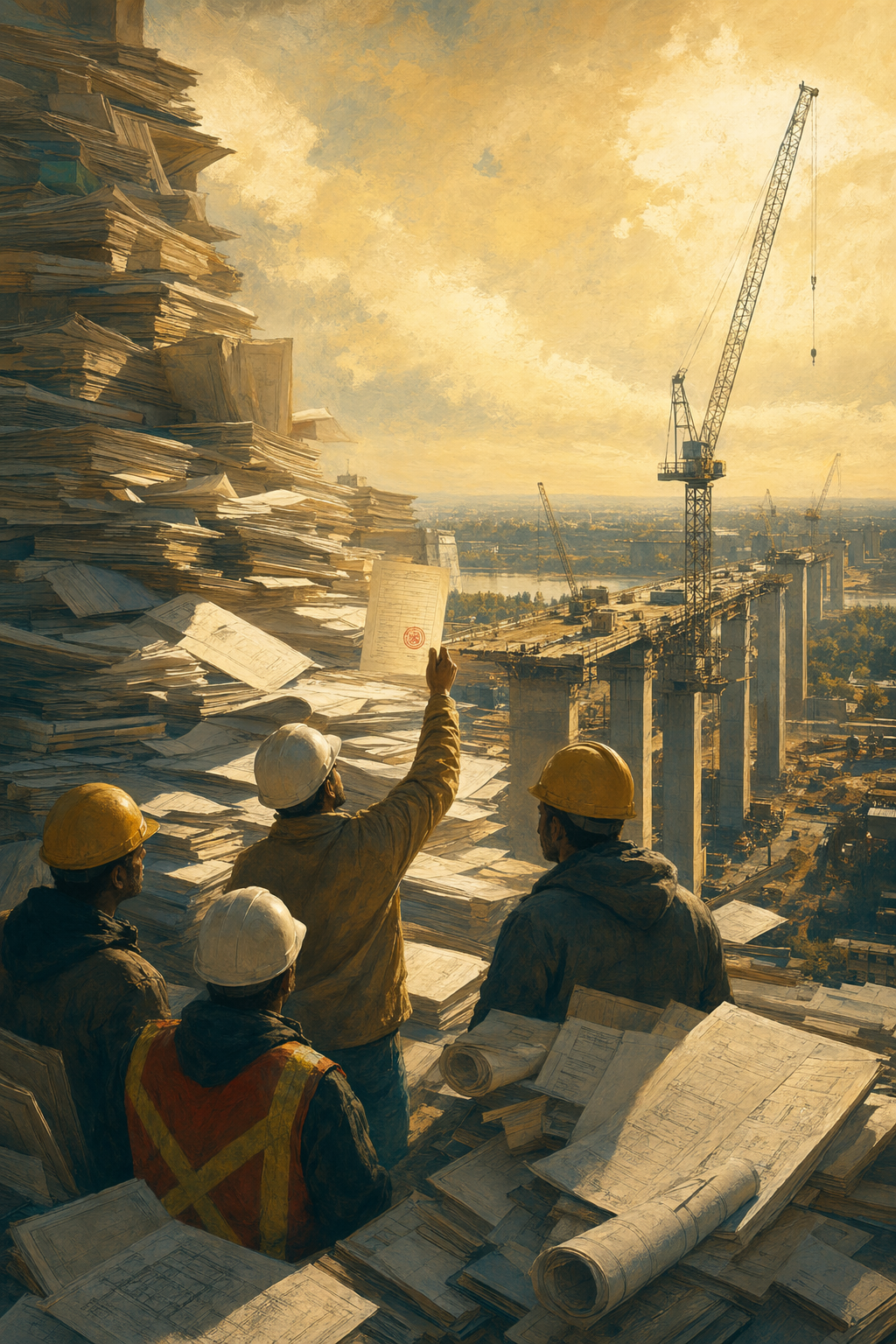
Modern states, especially wealthy ones, have become slow, expensive, and unable to execute physical projects. Housing, energy, transit, scientific infrastructure — all take decades and cost multiples of what they should. We used to be able to build things. We can’t anymore, or not easily, and the reasons are tangled: regulatory accretion, legal vulnerability, political fragmentation, civil service attrition, risk aversion. There is no single intervention.

But this is the problem sitting underneath most of the other civilization-scale problems in this book. Climate, housing, energy, pandemic response, AI infrastructure — the ideas exist and the execution does not. The countries that recover state capacity first will lead the century. Reform requires political will plus institutional understanding, and very few people have both, which is itself part of the problem.

Something is changing, though. The dysfunction is now impossible to ignore. A cross-partisan conversation about abundance and execution is actually happening. A generation of younger reformers has started taking state capacity seriously as a problem in its own right rather than as a secondary concern. The curriculum for this work is practical: try to build something small, see what blocks you, trace the block to its source. That’s where the real education is, and that’s where the leverage for reform ends up.

Start with: the Institute for Progress, Works in Progress magazine, Ezra Klein on abundance. Then try to build something small yourself and see what blocks you. That is the curriculum.
↑ Contents
Plate 27
V · CIVILIZATION № 27
27

Demographic collapse

Birth rates across the developed world — and now increasingly the developing world — have fallen below replacement and keep falling. South Korea is at 0.7. China is shrinking. Italy, Japan, most of Europe. Pronatal policies have mostly failed. Cash subsidies help at the margins. Nothing yet discovered moves fertility from 1.3 back to 2.1, and nobody really has a working model of why.

The causes are a tangle of economics, culture, housing, gender norms, and something harder to name about modern life and meaning. The long-term consequences are civilizational: collapsing tax bases, unsustainable pension systems, abandoned infrastructure, cultural transmission failures. This isn’t numbers on a spreadsheet. It’s whether the civilization wants a future badly enough to have one.

South Korea is the canary. Its population will halve within a century under current trends, which is demographic language for ‘this is being lived in real time by a society willing to look at it.’ The answers probably come from understanding why people who want children aren’t having them, or aren’t having as many. Which is more instructive than the policy literature currently reflects. A civilization with a future has people in it who want it, and right now it’s less clear than it should be that we do.

Start with: Lyman Stone’s work. The Korean case. Ask yourself honestly why you or the people you know do not have more children. The answers are more instructive than the policy literature.
↑ Contents
Plate 28
V · CIVILIZATION № 28
28

Education

Education is how humans become humans. We know a great deal about how learning works in principle and very little about how to deliver it well at scale in practice. Public systems were designed for an industrial economy that no longer exists. Private alternatives are accessible to few. The gap between what we know about learning and how education is actually delivered is one of the largest and most consequential gaps in any field.

Something is genuinely shifting. AI tutoring is real and working in early experiments. The cost of one-on-one high-quality instruction is finally falling below the cost of the industrial system it could replace. Benjamin Bloom’s two-sigma result — tutored students outperforming classroom students by two standard deviations — was a tantalizing benchmark for forty years because nobody could afford to deliver it. We can now.

A generation raised with tutoring-level attention, who actually love learning because the system hasn’t crushed it out of them by twelve, who can retrain themselves in new domains deep into adulthood — the labor transition becomes navigable because of that, and the meaning crisis eases because people have been formed into something rather than processed through a credentialing machine. Education reform fights tradition at every level, and most of the authority to change the system sits with people who don’t have the expertise. But the space for real experimentation is larger than it’s been in a century.

Start with: Benjamin Bloom’s two-sigma work as the baseline of what is possible. The AI tutoring research. The classical education revival as one serious experiment in alternatives. Then think about what you wish your own education had been.
↑ Contents
Plate 29
V · CIVILIZATION № 29
29

Trust and coordination at scale

Almost every coordination failure in human history comes down to trust. High-trust societies outperform low-trust ones by enormous margins on nearly every metric — economic, civic, personal. And trust — in institutions, in media, in strangers — has been declining across developed societies for decades, which means the compound gains of cooperation are eroding at exactly the moment we’re facing problems that require more of it, not less.

Cryptographic primitives — zero-knowledge proofs, verifiable computation, transparent institutions — are one piece of the answer. For the first time, trust doesn’t have to come from knowing a person; it can come from math. But that’s just tooling. The deeper problem is cultural: trust is built slowly and destroyed quickly, and institutional trust depends on institutions actually being trustworthy, which many currently aren’t.

The work is part institutional design, part cultural, part technical. A small community of people is starting to take institution-building seriously as a discipline after decades of it being unglamorous. The institutions that earn trust because their trustworthiness is visible, not asserted — the ones where you can check — are going to be one of the defining design challenges of the century, and the compound gains from getting this right are hard to overstate.

Start with: the verifiable institutions literature. The trust research in economics. Think concretely about which existing institution’s trust bottleneck you could actually dissolve.
↑ Contents
VI

SUBSTRATE

The physical ground everything rests on. When the substrate loosens, everything above shakes.

Plate 30
VI · SUBSTRATE № 30
30

Energy abundance

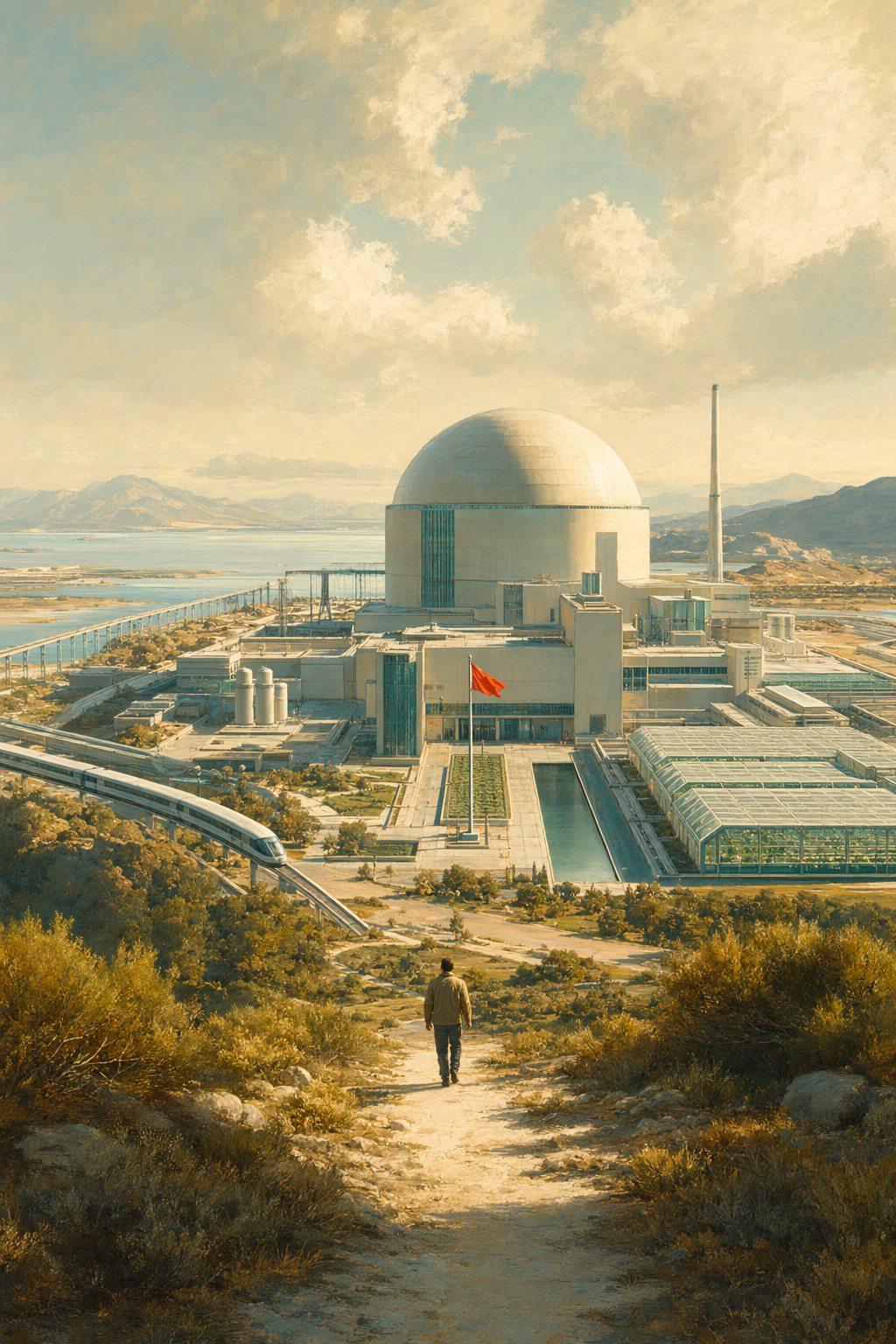
Energy is the master resource. Cheap, abundant energy makes desalination, vertical farming, carbon removal, mass transit, space access, and compute all trivial. An order of magnitude reduction in energy cost dissolves most of the crises we currently think of as separate. We have the technologies — advanced nuclear, enhanced geothermal, fusion — and we haven’t deployed them at scale. The bottleneck isn’t physics. It’s regulation, capital, and political will.

Each pathway is blocked in its own specific way, but each pathway is also finally in the deployment phase rather than the research phase. Oklo is building advanced reactors. Commonwealth Fusion is producing net gain. Fervo has enhanced geothermal operational. The next decade determines which pathway — or combination — scales first.

When one does, the downstream effects compound through nearly every problem in this book. Climate adaptation becomes cheap. Water and food constraints soften. Compute stops being a civilizational bottleneck. Industrial processes get rebuilt around abundance instead of scarcity. Energy is the problem where ‘why now’ has the clearest answer: because we finally have real options on the table and the work is shipping them.

Start with: Oklo, Commonwealth Fusion Systems, Fervo Energy. Eli Dourado’s writing. The Breakthrough Institute. Understand where the real bottleneck sits for each technology.
↑ Contents
Plate 31
VI · SUBSTRATE № 31
31

Food systems and soil

Agriculture feeds eight billion people and is losing the soil it does it with. Topsoil is being lost faster than it’s being formed. Industrial monoculture depletes it. The cheap-food system that underwrites modern civilization is quietly drawing down a substrate that took millennia to build, and the horizon on soil degradation is measured in decades, not centuries.

This is one of the least-glamorous civilization-ending problems on the list, and it’s exactly under-attended because it’s unglamorous. But the tools are finally arriving. AI-driven agronomy. Precision agriculture sensors that can track soil biology at field scale. Precision fermentation and cellular agriculture that reduce land-use pressure and offload some of the demand entirely. Nitrogen fixation alternatives that don’t require Haber-Bosch running at current scale.

A food system that improves its substrate rather than consuming it is scientifically and economically possible. What it requires is people willing to work on agriculture — which, because it’s unfashionable in tech circles, is exactly the kind of place where a serious person can have outsized impact. Visit an actual farm. Understand the system from inside it. The theory is well-developed. The work of implementation at scale is where the real leverage sits.

Start with: the regenerative agriculture literature, David Montgomery on soil, the precision fermentation space. Then visit an actual farm and understand what the system looks like from inside it.
↑ Contents
Plate 32
VI · SUBSTRATE № 32
32

Water

Much of the world’s food production runs on groundwater, and the aquifers being drawn from — the Ogallala under the Great Plains, the aquifers under the North China Plain, the depleted systems under northern India — took tens of thousands of years to fill and are being emptied in decades. This isn’t theoretical scarcity. It’s physical depletion with a visible endpoint. When the aquifers are gone, the agriculture they support collapses.

The failure mode — regional agricultural collapse, forced migration, resource conflict — is one of the clearer mass-suffering scenarios of the next fifty years, and it’s being sleepwalked toward. The political economy of water allocation in most jurisdictions was set under assumptions that no longer hold, and the water rights are often constitutionally protected, which makes reform hard.

But desalination costs are falling sharply as renewable energy scales and membranes improve. Precision agriculture can dramatically reduce water use without cutting yield. Aquifer monitoring data has finally gotten comprehensive enough to see exactly what’s coming. The cost of acting now is far lower than the cost of acting after regional failures begin. Water is local — every region has its own system with its own specifics — which is why the work is concrete: pick a region, understand its water system in detail, work the actual problem. The general problem is the sum of specific cases.

Start with: the Pacific Institute water research. The desalination economics. The aquifer depletion data. Pick a specific region and understand its water system; the general problem is the sum of specific cases.
↑ Contents
Plate 33
VI · SUBSTRATE № 33
33

Climate adaptation

Mitigation gets most of the climate attention. Adaptation — living well in the warmer world that’s already locked in — gets much less, even though even the optimistic scenarios involve substantial warming from here. Adaptation is also less politically attractive than mitigation because it’s an implicit admission that some of the change is coming regardless, which means it attracts less talent and less funding relative to its importance.

But the warming isn’t a forecast anymore. It’s a present condition. The engineering challenges are concrete and local. Every coastline, agricultural region, and city needs its own plan. The wealthy regions will adapt; whether the poorer ones will, and whether global adaptation infrastructure emerges in time, is the open question.

The regions that move first will absorb shocks better. Coastal cities that survive sea level rise without depopulation. Agriculture that functions in shifted climate zones. Health systems prepared for expanded disease ranges. The work is specific and tangible and needs engineers and planners willing to take it as seriously as a generation of climate scientists took mitigation. A civilization that meets the warming with engineering rather than retreat looks like people making their specific regions function in their specific new conditions. Pick a place. Understand what adaptation looks like for it. That’s the work.

Start with: the IPCC adaptation reports, the resilient cities literature, the agricultural adaptation research in the Global South. Then pick a specific place and understand what adaptation looks like for it in detail.
↑ Contents

A closing note

Thirty-three problems. There are more. Some are missing from this list because I don’t know about them yet. Some are missing because I cut them to get to a number that felt like a life’s work rather than a library’s.

You don’t need to work on all of them. You don’t need to agree with the list. You need to find one thing where the door has opened and walk through it while it is open. That’s the whole exercise. The moment is unusual. Most moments aren’t.

— A working draft.

· · ·